

What Is a 3-in-1 Bedside Commode? Bedside and Over-Toilet Use Explained
A 3-in-1 bedside commode is one of those product categories that sounds familiar but often gets misunderstood. Some shoppers think it is only a bedside toilet chair. Others assume it can replace any bathroom support product. In reality, the correct choice depends on the exact model, the user's needs, the transfer routine, and the space where the product will be used.
In general, a 3-in-1 bedside commode is a stationary toileting support product designed for bedside use or placement over a compatible standard toilet. Depending on the exact model and instructions, the same frame may support more than one setup. That does not mean every product in this category works the same way, and it does not mean every environment is compatible without checking fit first.
This guide explains what a 3-in-1 bedside commode is, how bedside and over-toilet use differ, what measurements matter before buying, and which details should be checked before regular use. It is a product-information guide, not a transfer-training guide or a substitute for individualized professional advice.
The short version
Before buying a 3-in-1 bedside commode, check these points:
- Confirm that a stationary commode is the correct product category for the intended user.
- Identify the intended setup: bedside use, over-toilet use, or both.
- Measure the available floor space and toilet clearance.
- Compare seat height, armrest support, and overall frame dimensions.
- Check whether the bucket, splash guard, and other included parts match the intended use.
- Verify that all four legs can contact a firm, level floor.
- Confirm the published weight capacity and current instructions for the exact model.
- Inspect adjustment buttons, armrests, rubber tips, and the removable components before use.
1. What does “3-in-1” mean?
The phrase “3-in-1” is common in this product category, but it is not always explained clearly. In practice, it usually refers to a commode-style frame that can support more than one toileting setup, depending on the exact design and instructions.
The important point is this: do not assume the name alone tells you everything. One product may support bedside use and over-toilet use. Another may include different accessories or setup options. The exact model's current instructions always matter more than the marketing label.
So before buying, ask a simple question: What exact job does the product need to do in this home?
2. Bedside use: when and why people consider it
Bedside use is often considered when the intended user cannot reach the bathroom quickly, safely, or consistently. That may be because of limited mobility, nighttime urgency, temporary recovery needs, or the layout of the home.
In a bedside setup, the product is placed on a firm, level floor close to the bed or another planned location. The user transfers to the commode chair there rather than traveling to the toilet each time.
When evaluating bedside use, check:
- Whether there is enough clear floor space beside the bed.
- Whether the user can approach and transfer using the planned method.
- Whether the armrests help with positioning and support.
- Whether the seat height is appropriate for the intended user.
- Whether the bucket and lid are easy to remove, empty, and clean as instructed.
If the bedside position is cramped, unstable, or difficult to access at night, the setup may not work well even if the product itself is appropriate.
3. Over-toilet use: how it differs
Some 3-in-1 bedside commodes can also be placed over a compatible standard toilet. In that arrangement, the commode frame provides supportive armrests and a raised seating setup while the toilet remains underneath.
Over-toilet use is not automatic. The product has to fit the toilet area and leave enough space for safe access. The frame must not interfere with the toilet, surrounding walls, or other fixtures.
Before using a commode over a toilet, check:
- The height and position of the toilet.
- The available floor space around the toilet base.
- Whether the frame sits evenly and securely around the toilet.
- Whether the user can approach, turn, and transfer in the available space.
- Whether a caregiver, if needed, can still assist safely.
A product may fit the toilet opening but still fail because the bathroom is too tight around it. The real question is not just whether it goes over the toilet, but whether the complete setup works in daily use.
4. What a 3-in-1 bedside commode is not
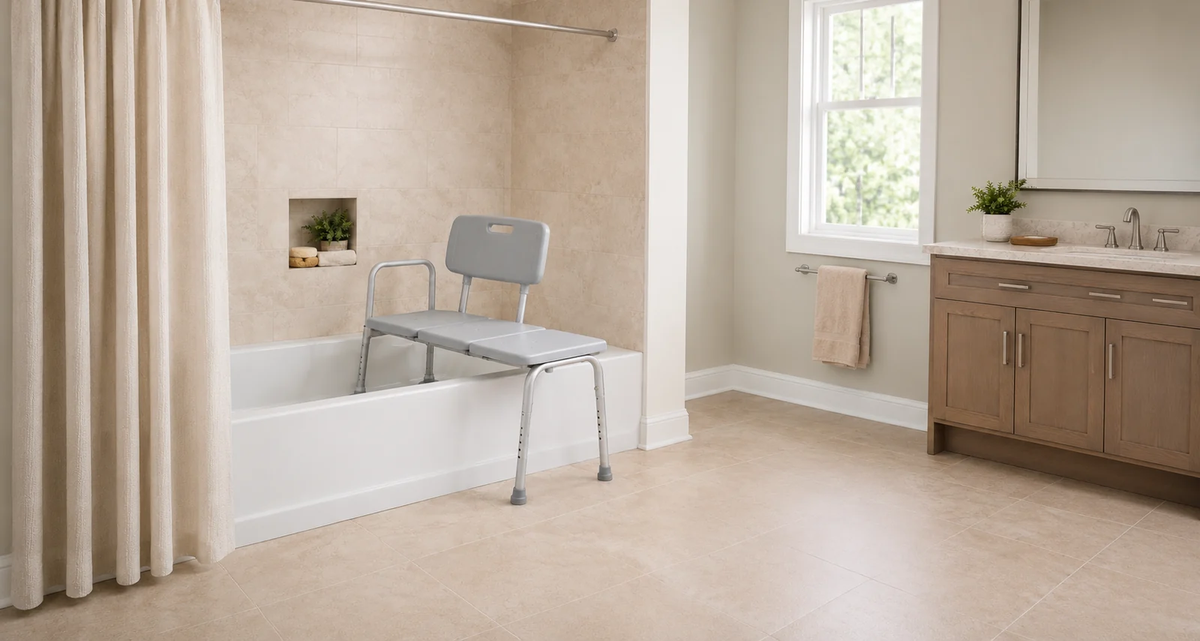
A 3-in-1 bedside commode is not the same as a shower chair, transfer bench, or mobile shower commode chair.
- Shower chair: usually used inside a compatible shower or bathing area.
- Transfer bench: usually used to create a seated route across a compatible tub wall.
- Mobile shower commode chair: usually has wheels, locking casters, and a caregiver-assisted routine for bathing or toileting in a compatible space.
A stationary bedside commode should not be chosen simply because it looks similar to another bathroom-support product. The transfer method, placement, and environment all matter.
If you want a broader product-category comparison, see Shower Stool vs. Transfer Bench vs. Shower Commode Chair: What’s the Difference?.
5. What to measure before buying
Dimensions matter, but the useful measurements are not limited to the seat alone. Before choosing a 3-in-1 bedside commode, measure the real space where it will be used.
Floor space
Measure the clear, usable floor area at the intended location. Include nearby furniture, walls, and the route the user takes to reach the chair.
Toilet clearance
If over-toilet use matters, measure the toilet area and the surrounding clearances, not just the toilet itself.
Transfer space
Check whether the user can approach from the intended side and whether armrests, walls, or furniture interfere with the transfer path.
Seat height
Compare the product's seat-height range with the intended user's needs. A commode that is too low or too high can make transfers harder, even when the footprint fits the room.
Overall frame size
Look at the complete frame dimensions, not just the opening or the seat width. The legs and armrests are part of the product's real footprint.
6. Which features matter most?
Different shoppers focus on different details, but these features usually deserve attention:
- Height adjustment: helps match the setup to the user and the intended use.
- Supportive armrests: can help with positioning and controlled transfers.
- Removable bucket: matters for bedside use and cleaning routine.
- Splash guard: matters when the product is placed over a compatible toilet.
- Rubber-tipped legs: help create stable floor contact on a firm, level surface.
- Cleaning access: daily use becomes harder if parts are difficult to remove or clean.
These features should be evaluated together. A product can have the right height range but still be a poor match if the floor space is too tight or the transfer route does not work.
7. What to inspect before each use
Like other home-care support products, a bedside commode should be inspected routinely.
Before use, check for:
- All four legs contacting the floor evenly.
- Fully engaged height-adjustment buttons.
- Secure armrests and frame connections.
- Rubber tips that are present, secure, and not worn out.
- A bucket, lid, or splash guard that is positioned correctly for the intended setup.
- No looseness, bending, cracking, or missing parts.
If the product rocks, shifts, feels unstable, or shows visible damage, stop using it until the problem is identified and corrected according to the current instructions.
8. When to seek professional guidance
A bedside commode is not just a furniture decision. If the intended user has balance problems, weakness, pain, recent surgery, cognitive changes, complex transfers, or repeated falls, a qualified occupational therapist, physical therapist, or other healthcare professional should help assess the setup.
The right product category, height, transfer method, and placement depend on the individual—not only on the room dimensions.
Final takeaway
A 3-in-1 bedside commode can be a practical toileting-support solution, but only when the exact product, the intended setup, and the user’s real environment all work together. Bedside use and over-toilet use are not identical tasks, and the correct buying decision should start with measurements, transfer needs, and the exact model's instructions.
If you are comparing options now, you can review the DeepTireh 3-in-1 Bedside Commode Chair and compare its current specifications, included components, and intended use with your home setup.


Leave a comment
This site is protected by hCaptcha and the hCaptcha Privacy Policy and Terms of Service apply.