

Shower Stool vs. Transfer Bench vs. Shower Commode Chair: What’s the Difference?
A shower stool, bathtub transfer bench, and mobile shower commode chair may look similar, but they solve different problems. A stool provides compact seating after the user enters a compatible bathing area. A transfer bench creates a seated route across a compatible tub wall. A mobile shower commode chair combines a wheeled, caregiver-assisted frame with bathing and toileting functions.
The choice should begin with the bathroom layout, transfer route, available space, and assistance required—not appearance alone. Always check the dimensions, published capacity, and instructions for the exact model.
This guide is a practical starting point—not an individual medical, mobility, or home-safety assessment. If balance, strength, transfers, or recent falls are a concern, ask a qualified healthcare professional or occupational or physical therapist to assess the situation.
Quick comparison
Shower stool
- Main purpose: Compact seated support during bathing.
- Placement: Fully inside a compatible shower or tub.
- Movement: Stationary.
- Check first: Available floor space, seat height, leg adjustment, stable foot contact, and weight capacity.
Bathtub transfer bench
- Main purpose: Seated entry and exit across a compatible tub wall.
- Placement: One side outside and one side inside the tub.
- Movement: Stationary.
- Check first: Tub-wall clearance, door or curtain interference, leg placement, seat height, and outside floor space.
Mobile shower commode chair
- Main purpose: Caregiver-assisted bathing, toileting, and indoor repositioning.
- Placement: Compatible level shower and commode areas.
- Movement: Rolls on casters, then locks for stationary use.
- Check first: Doorway and threshold clearance, turning space, caster locks, caregiver assistance, and weight capacity.
1. When a shower stool may be the better starting point
A shower stool is usually the most compact option. It sits entirely inside a compatible shower or tub and may suit a smaller space when the user can already enter and leave the bathing area using an appropriate routine.
The key limitation is important: a shower stool does not help a person move across a bathtub wall. The user still needs an appropriate way to enter the tub or shower before sitting down. It should not be treated as a transfer bench, step, or standing platform.
Measure usable floor area, not only the overall shower or tub. The feet must rest fully on a firm, level surface rather than a curve, drain lip, or unstable mat. Compare the height range, seat dimensions, and stated capacity with the intended user and space.
The DeepTireh Padded Shower Stool weighs 3.6 lb and has a published 300 lb capacity. It includes an adjustable frame, padded seat, low back support, side handles, and wide rubber feet. All four feet must remain in full contact with a firm, level shower or tub floor, and the stool must never be used for standing.
2. When a bathtub transfer bench may be the better starting point
A bathtub transfer bench is intended for crossing a compatible tub wall while seated. Part rests outside the tub and part rests inside, allowing the user to sit before moving across the seat.
Fit is more complicated than with a stool. A bathroom may have enough room inside the tub but insufficient clear floor space outside it. Sliding doors, curved tub walls, nearby fixtures, or the bathroom door may also interfere.
Measure the tub wall, floor area on both sides, and approach path. Confirm that the curtain or enclosure remains compatible. Every leg must contact its intended surface securely.
The DeepTireh Bathtub Transfer Bench weighs 14 lb and has a published 300 lb capacity. It includes a wide seat, backrest, side handle, adjustable legs, and wide feet. Compatibility with the exact bathtub and surrounding space should be confirmed before purchase. It is a seat—not a standing platform.
3. When a mobile shower commode chair may be the better starting point
A mobile shower commode chair supports a more complex, caregiver-assisted routine involving seated bathing, toileting, and limited indoor repositioning in a compatible environment.
Its casters make doorway width, thresholds, turning clearance, locks, and caregiver handling part of the decision. Fitting inside the shower is not enough if the chair cannot reach it or clear the toilet.
All casters must work correctly, and the chair must be fully locked before a transfer or stationary activity. Use only the orientation and method specified by the manufacturer. Do not assume that a shower commode chair is a general-purpose wheelchair.
The DeepTireh Mobile Shower Commode Chair weighs 21 lb and has a published 220 lb capacity. It includes locking casters, armrests, a built-in footrest, and a removable commode bucket. It is intended for forward-facing, caregiver-assisted use on suitable level indoor surfaces. Lock every caster before transfers or stationary use.
Where does a standard shower chair fit?
A standard shower chair usually sits fully inside a compatible bathing area but often adds a backrest or arms. It does not normally span a tub wall or include the casters and toileting features of a mobile shower commode chair. Product names vary, so verify the frame, placement, transfer method, dimensions, and instructions rather than relying on the title.
Seven checks to make before choosing
1. Identify the bathing arrangement
Identify the fixture and note any threshold, door track, curtain, or hinged door.
2. Map the complete transfer route
Trace the complete route to the bathing or toileting position. Check for obstructions and whether the required assistance is actually available.
3. Measure clearances, not just the room
Measure usable floor space, doorway width, thresholds, space beside the tub, toilet clearance, and turning room. Include handles, casters, and armrests.
4. Check the fit for the intended user
Compare the permitted seat-height range and dimensions with the intended user. If positioning or transfer technique is uncertain, seek an individualized assessment.
5. Confirm the exact weight capacity
Use the published capacity for the exact model. Similar-looking products may have different ratings.
6. Check floor contact, drainage, and locks
Stationary products need secure floor contact; wheeled products need working locks and space to become fully stationary. Account for water, residue, mats, drains, and uneven surfaces.
7. Review setup, cleaning, and support
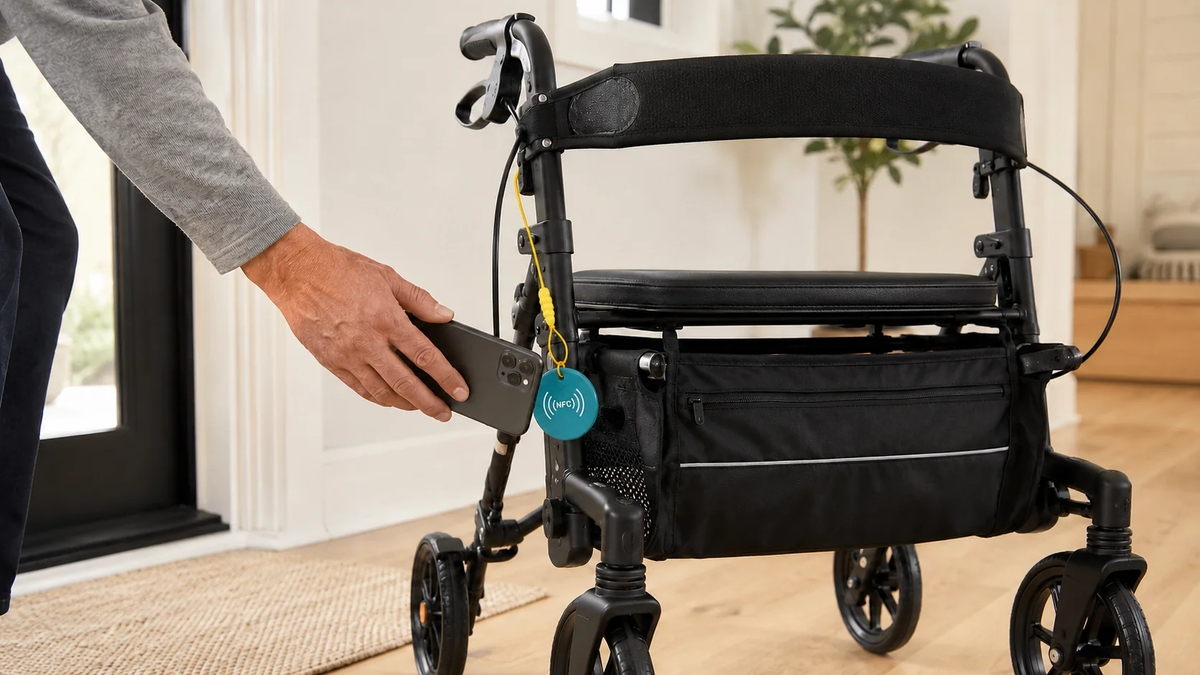
Read the manual and confirm assembly, adjustment, inspection, cleaning, and drying requirements. On DeepTireh NFC Ready models, a compatible phone can open available model-specific installation or setup videos, customer-support access, and product registration. NFC does not replace the manual, a compatibility check, or professional guidance.
Which type should you compare first?
- Need a compact seat after entering a compatible bathing area? Begin by comparing shower stools or shower chairs.
- Need a seated route across a compatible bathtub wall? Begin by comparing bathtub transfer benches.
- Need a caregiver-assisted wheeled option for bathing and toileting routines? Begin by comparing mobile shower commode chairs.
- Unsure about balance, transfers, positioning, or required assistance? Ask a qualified occupational therapist, physical therapist, or other healthcare professional to assess the user and bathroom.
These prompts narrow the category; they do not confirm that a particular model fits a particular person or bathroom.
DeepTireh bath-support models at a glance
Padded Shower Stool
- Product weight: 3.6 lb
- Published capacity: 300 lb
- Main role: Compact stationary seating inside a compatible shower or tub.
Bathtub Transfer Bench
- Product weight: 14 lb
- Published capacity: 300 lb
- Main role: Stationary seated transfer across a compatible bathtub wall.
Mobile Shower Commode Chair
- Product weight: 21 lb
- Published capacity: 220 lb
- Main role: Forward-facing, caregiver-assisted bathing and toileting support on suitable level indoor surfaces.
Published specifications should always be rechecked on the exact product page and in the current manual before ordering or use.
Before first use
- Confirm that the model, parts, assembly, and adjustment match the instructions.
- Inspect fasteners, feet, casters, locks, seat surfaces, and handles.
- Test the product in its intended location and confirm every clearance.
- Confirm full foot contact on stationary products and test every caster lock on mobile models.
- Follow the cleaning, drying, inspection, and maintenance instructions.
- Stop using the product if any component is loose, damaged, unstable, or malfunctioning.
Frequently asked questions
Can a shower stool replace a transfer bench?
No—not unless the product is specifically designed and labeled for that purpose. A shower stool sits inside a compatible bathing area; a transfer bench is designed to cross a compatible bathtub wall.
Will a bathtub transfer bench fit every tub?
No. Tub-wall dimensions, floor space, doors, curtains, nearby fixtures, leg placement, and the product’s adjustment range all affect compatibility.
Can a mobile shower commode chair be used as a wheelchair?
Do not assume so. Follow the intended use and limitations for the exact model. The DeepTireh model is designed for forward-facing, caregiver-assisted use on suitable level indoor surfaces and is not intended for roadway or vehicle transport.
Does Smart NFC replace the product manual or professional guidance?
No. On DeepTireh NFC Ready products, NFC provides quick access to available real, model-specific installation or setup videos, customer support, and registration resources. It does not assess the user, confirm bathroom compatibility, or replace the manual or qualified guidance.
Can bathroom support equipment eliminate fall risk?
No product can eliminate risk. Appropriate product selection, correct fit, proper setup, a suitable environment, regular inspection, and the right level of assistance all matter.
Compare the right support for your routine
The most useful comparison is not simply “Which seat has the most features?” It is “Which product is designed for this bathroom, this transfer route, and this level of assistance?”
Compare DeepTireh Bath & Toilet Safety products, review the specifications for each exact model, and contact DeepTireh Support if you have a product-specific question before ordering.
Reference resources
- CDC — Still Going Strong: Older Adults
- CDC — Nonfatal Bathroom Injuries Among Persons Aged 15 Years and Older
- U.S. Department of Veterans Affairs — Balance, Falls, and Home Safety
- MedlinePlus — Mobility Aids
Medical and safety note
This article provides general educational information and is not medical advice, diagnosis, treatment, or an individualized safety assessment. Product suitability depends on the intended user, environment, setup, and assistance available. Follow the current instructions and warnings supplied with the exact product, and consult a qualified professional when individual guidance is needed.


Leave a comment
This site is protected by hCaptcha and the hCaptcha Privacy Policy and Terms of Service apply.