



Learning how to use a rollator walker starts before the first walk: understand the controls, check that the frame is secure, and make sure the aid suits you. Then begin with a short, familiar route on level ground.
This guide covers four-wheel rollators with hand brakes. A standard walking frame, a two-wheel walker, and a transport chair work differently. Use the aid recommended for you and follow its manual and your healthcare professional’s instructions. Memorial Sloan Kettering explains why model-specific instructions matter.
1. Before your first walk
Can you operate both brakes comfortably? Will the rollator fit your usual routes? If your clinician has restricted weight through a leg, confirm which aid to use. Alberta Health Services discusses suitability for a four-wheel walker.
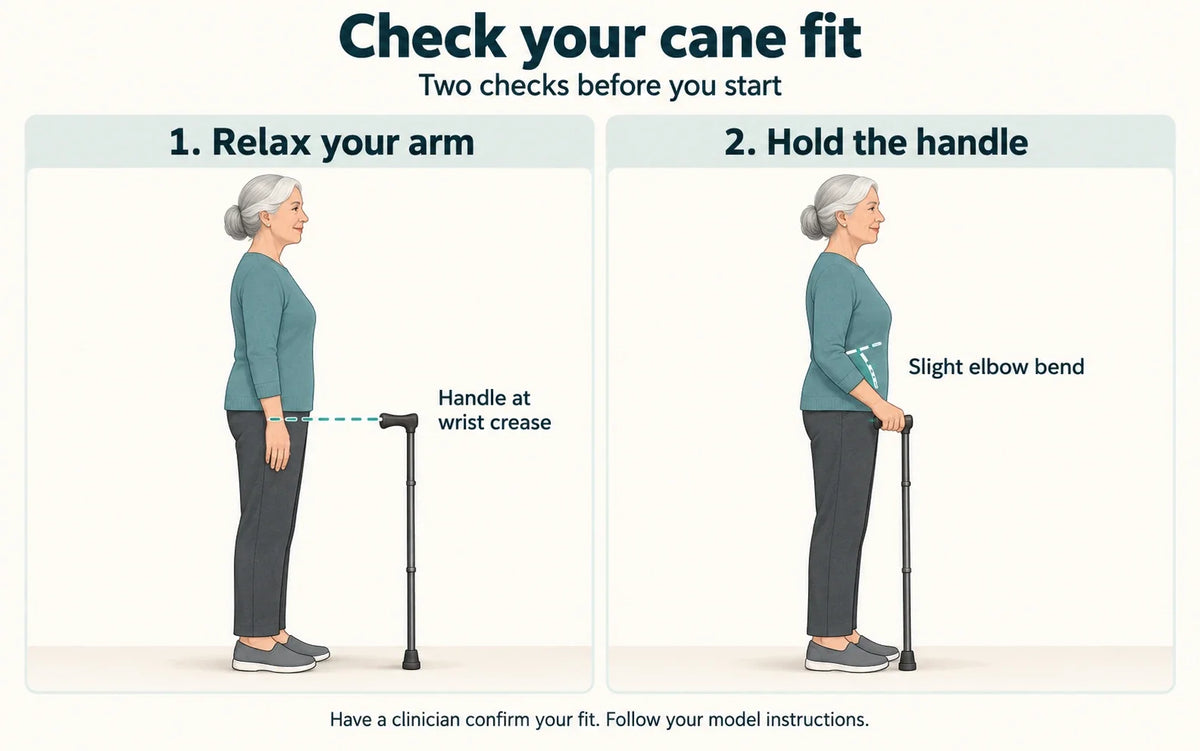
For handle height, a common starting point is wrist level while standing upright with your arms relaxed. The final fit needs to work for your posture and usual footwear; adjust and secure the handles using your model’s instructions. See our handle-height guide and MSK’s adjustment overview.

2. A quick check before each use
Check the rollator after unfolding it and before putting it to use. The HY8516L user manual is the reference for that model’s assembly and controls; use the matching manual for a different product.
| Check | What to look for |
|---|---|
| Frame and locks | Fully opened frame; the unfolding lock secured as described in the manual. |
| Handles and fittings | Height adjustments secured, with no loose joints or damaged parts. |
| Brakes | Both service brakes respond; both parking brakes hold during the prescribed check. |
| Wheels and route | No obvious damage or trapped debris; a clear, dry route ahead. |
| Seat and storage | Seat and any back support fitted correctly; belongings carried only as the manual allows. |
If a lock does not engage or a brake fails to hold, stop and arrange servicing. NHS Forth Valley recommends regular checks; the byACRE safety manual calls for defective equipment to be taken out of use.
3. Walking and turning on level ground
Begin on a clear, level surface. Hold both hand grips, establish your balance, and release the parking brakes using the method for your model. Walk close to the frame, looking ahead, with the rollator moving along with your steps. Avoid stretching your arms to chase it.
For a turn, keep hold of the grips and move slowly through a roomy curve. Take small steps with the turn instead of twisting on a planted leg. If the rollator regularly runs ahead of you on level ground, ask a healthcare professional to review its suitability and setup. These basics follow Alberta Health Services’ walking and turning guidance.
When getting up from an ordinary chair, push up from its arms or seat, then move your hands to the rollator once steady. Do not pull on the rollator to lift yourself. NHS Forth Valley describes this sequence.
4. Braking and taking a seated rest
Learn the difference between slowing the wheels and parking them. Many lever-brake rollators slow when the levers are squeezed and park when the levers are pushed down into a locked position. The release action varies, so practise the exact method in your manual before relying on it. Our service-brake and parking-brake guide explains the distinction.

If your model has a rest seat, stop on firm, level ground and lock both parking brakes before sitting. Keep them locked throughout the rest. Follow your manual for sitting and standing. NHS Forth Valley’s seat guidance rules out slopes and uneven ground; the byACRE manual’s safety instructions explain the brake precautions.
A rollator seat does not make it a wheelchair. Do not scoot along while seated or have someone push an ordinary rollator with you on its seat. A product designed for seated transport is a separate configuration with its own instructions; do not assume that function from a seat or backrest.
5. Home routes, folding, and storage
A clear doorway is only one part of a usable route. Think through the turn beyond it, loose rugs, thresholds, and where you can stop without blocking the passage. Use our home-measurement guide to compare your space with the exact product’s overall dimensions.
Choose dry, even routes; avoid wet floors, ice, and slippery leaves. Do not use a rollator on stairs. Ask your clinician about alternatives for difficult routes. NHS Forth Valley lists these precautions.
For storage, follow the model’s folding sequence and keep fingers clear of moving joints. Recheck the unfolding lock before the next use. See how to fold, store, and transport a rollator for the questions to check before putting it in a vehicle. A folding frame alone does not establish that it will fit your trunk.
6. Everyday questions
What if squeezing the brakes is difficult?
Ask your clinician or supplier to review the aid and its controls. Being able to reach a lever is not the same as being able to operate it reliably. Do not continue with a brake you cannot control.
Can I sit on the seat while someone pushes?
An ordinary rollator’s seat is for a stationary rest. Seated transport requires a product expressly designed for that purpose and its matching instructions.
Should I keep a parking brake on while walking?
Parking brakes hold the rollator stationary. Release them as your manual directs before walking; use the service brakes for controlled slowing. If a wheel drags or the brake will not release, stop and have it checked.
What should I check after taking it out of the car?
Repeat the pre-use checks, including the unfolding lock, handle fittings, and both brakes. Carrying or folding the rollator does not replace checking it when it is ready to use again.


Leave a comment
This site is protected by hCaptcha and the hCaptcha Privacy Policy and Terms of Service apply.