

How to Fold, Store, and Transport a Walker or Rollator
A folding mechanism can make a walker or rollator easier to store or place in a vehicle, but “foldable” does not mean every model closes the same way. Some walkers fold one side at a time. Some rollators fold front-to-back, side-to-side, or in more than one stage. Bags, back supports, trays, or other accessories may need different handling.
The safe approach is model-specific: identify the exact product, read its current manual, clear the mechanism, fold only at the intended controls, lift from approved structural points, and inspect the device again after transport.
This guide provides a general preparation sequence. It does not replace the folding, lifting, storage, or transport instructions for the exact model.
The short version
Before folding or transporting a walker or rollator:
- Move to a dry, level area away from traffic, stairs, and obstacles.
- Make sure no one is using or leaning on the product.
- Empty approved storage and remove accessories only when the manual requires it.
- Identify the release buttons, strap, lever, latch, or cross-brace used by the exact model.
- Keep fingers, clothing, cables, and loose items away from moving joints.
- Fold the product fully and engage any transport lock or clip.
- Lift only from the frame or other points approved in the manual.
- Place it in a measured, clean cargo space and prevent shifting.
- After transport, reopen it completely and inspect every required lock before use.
Do not use a partially folded or incompletely locked product for walking.
1. Confirm the exact model before folding
Similar-looking products can use different folding mechanisms. A general video or another model’s instructions may direct the user to the wrong strap, latch, button, or lifting point.
Before beginning, confirm:
- The model number on the product label.
- The current manual or official model-specific instructions.
- Whether the product is a standard walker, two-wheel walker, three-wheel rollator, four-wheel rollator, upright rollator, or another design.
- Whether the product has a transport lock or secondary compact-fold step.
- Which accessories may remain installed during folding.
- Where the approved lifting points are located.
If the product label and instructions do not match, stop and contact the manufacturer, supplier, or support resource.
2. Prepare a safe folding area
Fold the product while it is unoccupied on a dry, level, stable surface. Leave enough space to stand beside it without reaching across stairs, traffic, another person, or loose objects.
Before touching the mechanism:
- Remove hands, body weight, and personal items from the seat or frame.
- Keep children and pets away from the folding area.
- Move loose clothing, straps, and bags clear of hinges.
- Confirm that the product is stable in the position required by its instructions.
- Apply or release parking brakes exactly as directed for the folding procedure.
Do not improvise a folding position because the intended control is difficult to reach. Difficulty can indicate that the product is loaded, not fully opened, damaged, or being operated in the wrong sequence.
3. Empty storage before transport when required
Contents in a rollator bag or basket can shift, fall, catch in the frame, interfere with a latch, or change how the folded product balances.
Remove personal items before folding unless the exact instructions clearly permit them to remain. Pay special attention to:
- Phones, keys, and wallets.
- Bottles or liquids.
- Glasses and fragile items.
- Heavy or sharp objects.
- Items that can pass through a wheel or folding joint.
- Medical or personal information that should not remain unattended in a vehicle.
Never use the storage bag as a lifting handle unless the manufacturer explicitly identifies it for that purpose.
4. Handle accessories one at a time
A tray, cup holder, cane holder, back support, pouch, light, bell, or other accessory may change the folded dimensions or block the mechanism.
Check whether each accessory should be:
- Left installed.
- Folded into a designated position.
- Removed before folding.
- Packed separately.
- Secured so it cannot move during transport.
Do not force the frame closed around an accessory. Do not bend a brake cable, trap fabric in a hinge, or use the product’s folding pressure to hold a loose part in place.
Keep removed fasteners and approved parts together so that nothing is missing during reassembly.
5. Keep hands away from pinch points
Folding frames create moving gaps around hinges, cross-braces, seat rails, side frames, latches, and sliding tubes.
Use only the handles, straps, buttons, or frame areas identified for folding. Keep fingers and clothing away from:
- The center cross-brace.
- Seat rails and seat slides.
- Frame hinges.
- Sliding handle tubes.
- Wheel forks near folding joints.
- Accessory mounts that move with the frame.
Do not put one hand inside the frame while pulling a folding strap with the other. If a mechanism does not move normally, stop rather than increasing force.
6. Do not assume one folding method fits every product
Standard and two-wheel walkers
Many folding walkers use buttons, paddles, triggers, or release mechanisms near the upper frame. Some models fold one side at a time; others close both sides through a different sequence.
Confirm that the side frames move only in the intended direction and that wheels, tips, or glides remain attached as required.
Four-wheel rollators
Some rollators fold by lifting a strap under or through the seat. Others use a side-to-side cross-brace, a release handle, or a secondary compact-fold mechanism.
Do not pull the seat, bag, brake cable, or back belt unless the manual identifies that component as the folding control.
Other designs
Three-wheel, upright, hybrid, transport-capable, or specialty models may have additional latches, removable parts, or order-specific procedures. Their folding sequence should not be inferred from a standard walker or four-wheel rollator.
7. Confirm the folded product is controlled
After folding, look for the mechanism that keeps the product closed during lifting and transport. Depending on the design, this may be a clip, latch, strap, magnetic catch, or frame position.
Before lifting, confirm that:
- The product is fully folded according to the manual.
- Any required transport lock is engaged.
- No cable, fabric, or accessory is trapped.
- Wheels and tips remain attached securely.
- The frame will not open unexpectedly when raised.
- Loose parts are packed separately.
If the product does not stay folded as designed, do not tie it closed with an improvised cord or place it loose in a vehicle. Identify the cause and use the authorized solution.
8. Know the product weight and lifting points
Product weight is different from weight capacity and carton shipping weight. Use the confirmed assembled product weight in the configuration being lifted.
Also confirm what that number includes. A manufacturer may state product weight with or without a bag, back support, cane holder, or another accessory.
When lifting:
- Use approved solid frame sections or designated grips.
- Use both hands when the instructions or product shape require it.
- Keep the device close enough to control without twisting.
- Clear the path and cargo opening before lifting.
- Ask for assistance when the product’s weight, shape, or lift height is not manageable.
Do not lift by brake cables, a storage bag, a back belt, a removable tray, an accessory holder, or another component not designated as a lifting point.
For more on product weight and shipping weight, read Product Weight vs. Weight Capacity.
9. Measure the vehicle, not just the product
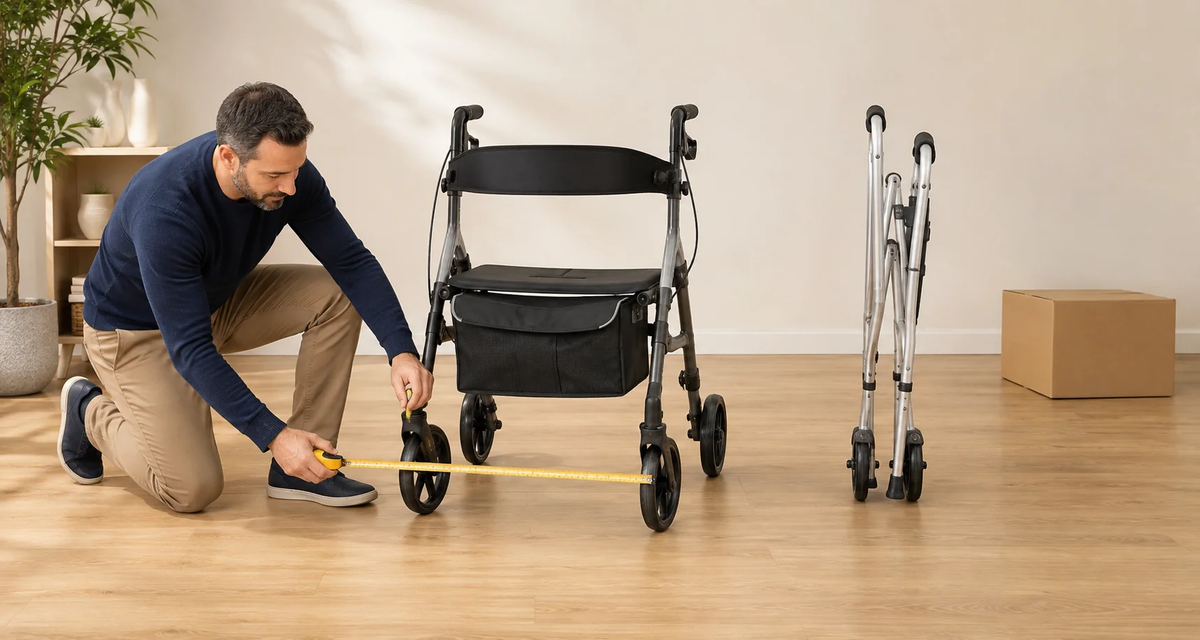
A product may fit inside a cargo area while being difficult to pass through the opening. Before relying on a vehicle for transport, compare:
- Folded width.
- Folded depth.
- Folded height.
- Cargo-opening width and height.
- Narrow points created by trim or hinges.
- Lift-over height from the ground.
- Usable cargo-floor depth.
- Space required by other regular cargo.
Do not compare only folded width. All three folded dimensions matter.
The DeepTireh guide Will a Walker or Rollator Fit Through Your Home? includes a practical vehicle cargo-opening check.
10. Place the product where it cannot shift
Use a clean cargo area with enough room for the complete folded product. Keep it away from loose heavy objects, sharp edges, leaking containers, excessive heat, and items that can press on brake cables, wheels, handles, or the frame.
Position and secure it according to the vehicle and product instructions. The goal is to prevent the device from:
- Rolling or sliding across the cargo floor.
- Opening unexpectedly.
- Striking the liftgate or window.
- Being crushed by other luggage.
- Trapping a brake cable or accessory.
- Becoming a loose object during travel.
Do not place unsecured heavy cargo on top of the folded product.
11. Store it without blocking the home
For storage outside a vehicle, choose a location that is dry, stable, and accessible without creating another obstacle.
Avoid locations that block:
- An exit or doorway.
- A stair or landing.
- A regular hallway.
- Access to emergency equipment.
- The space needed to reopen and inspect the product.
Protect the device from standing water, rain, excessive heat, damaging cold, and impact. Follow model-specific temperature and environmental limits when provided.
Do not lean an unsecured folded product where it can fall onto a person, pet, vehicle, or another object.
12. Reopen and inspect after transportation
Transportation can shift an accessory, catch a cable, loosen a component, or place pressure on the folded frame. Never assume the product is ready for use immediately after it leaves the vehicle.
On a dry, level surface:
- Remove the product from the cargo area using approved lifting points.
- Set it down in the position required for unfolding.
- Open the frame completely.
- Engage every required lock, latch, button, clip, or cross-brace.
- Reinstall approved accessories according to their instructions.
- Confirm matched height settings have not changed.
- Inspect wheels, tips, brakes, cables, seat, bag, back support, and fasteners.
- Test the unoccupied product as directed before regular use.
Stop if the frame does not open normally, a lock does not engage, a wheel or tip is loose, or braking behavior has changed.
Common mistakes to avoid
- Folding a device while someone is leaning on it.
- Using instructions for a similar model.
- Pulling a bag or seat that is not the folding control.
- Leaving heavy items in storage during lifting.
- Forcing the frame around an installed accessory.
- Placing fingers inside a moving hinge or cross-brace.
- Lifting by brake cables or removable parts.
- Comparing the trunk only with folded width.
- Leaving the device unsecured with heavy cargo.
- Walking before the reopened frame is fully locked.
Frequently asked questions
Can every walker or rollator fit in a car trunk?
No. Folded dimensions, cargo-opening dimensions, vehicle trim, other cargo, and the product’s folding method all vary. Measure the actual opening and usable cargo area.
Should I remove the rollator bag before folding?
Follow the exact model’s instructions. Even when the bag may remain attached, personal items may need to be removed so they do not shift, add weight, or interfere with the mechanism.
Can I carry a folded rollator by its seat strap?
Only if the manufacturer specifically identifies that strap as a carrying point. A folding strap is not automatically a lifting handle.
Can I lower the handles to make the product fit?
Only follow the permitted transport procedure for the exact model. Record or preserve the prescribed handle setting and confirm both sides after reopening.
Is a lighter product always easier to load?
Not necessarily. Shape, folded balance, grip points, cargo height, reach, and the individual’s lifting ability also matter.
Can I store a walker or rollator in the vehicle permanently?
Check the model’s storage limits and the vehicle environment. Heat, cold, moisture, theft risk, shifting cargo, and long-term pressure on components can make permanent vehicle storage inappropriate.
What if the frame will not lock after transport?
Do not use it. Check for trapped fabric, accessories, visible damage, or an incomplete unfolding sequence, then follow the exact support instructions for the model.
Folding is a sequence, not a shortcut
A folding feature is useful only when the correct model-specific sequence is followed from start to finish: prepare the area, clear the storage, manage accessories, protect hands from pinch points, close the frame fully, lift from approved points, secure the product during transport, and inspect it after reopening.
When the mechanism, lifting point, accessory configuration, or post-transport condition is uncertain, stop and confirm the instructions before use. For DeepTireh model information and support resources, visit the DeepTireh Support Center.


Leave a comment
This site is protected by hCaptcha and the hCaptcha Privacy Policy and Terms of Service apply.