

Rollator vs. Walker vs. Cane: What’s the Difference?
Short answer: A cane, a walker, and a rollator are not interchangeable. A cane is controlled with one hand, a two-wheel walker uses a two-handed frame with front wheels and rear tips, and a rollator moves continuously on wheels and is controlled with hand brakes. The right category depends on the user’s balance, strength, hand control, walking pattern, environment, and ability to operate the device safely.
This guide compares the practical differences between a rollator, walker, and cane. It does not provide an individual medical or mobility assessment. A healthcare professional or physical therapist can help select and fit a mobility aid, especially after surgery, injury, a recent fall, or a change in walking ability.
Rollator vs. walker vs. cane at a glance
| Category | Practical difference |
|---|---|
| Cane |
Control: One hand; placed with each step according to the user’s trained walking pattern. Features: No hand brakes or seat. Ask first: Is one-handed support appropriate for the intended user? |
| Two-wheel walker |
Control: Two hands; front wheels roll while rear tips remain on the walking surface. Features: Usually no hand brakes or built-in seat. Ask first: Can the user control the frame and keep both hands available? |
| Rollator |
Control: Two hands; rolls continuously and requires steering and speed control. Features: Hand brakes; many models include a seat and storage. Ask first: Can the user reliably steer and operate both brakes? |
These are general design differences, not a medical ranking. Suitability depends on the exact product, adjustment, user, and environment.
1. Cane: compact one-handed support
A cane has the smallest footprint of the three categories and is generally operated with one hand. Common designs include single-tip canes and canes with multi-point bases. Their compact size can make them easier to carry, store, and use in narrow spaces.
A cane does not provide a surrounding frame or a seat. The user must coordinate the cane with each step and keep the tip or base securely positioned. A freestanding or multi-point base should not be assumed to remain upright on every surface, and a cane should never be used as a transfer handle, step, or substitute for a properly installed grab bar.
Before comparing cane models, review the handle-height range, grip comfort, maximum user weight, base or tip condition, intended surfaces, and whether one-handed support is appropriate.
2. Two-wheel walker: a two-handed frame with rear tips
A two-wheel walker is held with both hands. Its front wheels roll forward while the rear rubber tips remain in contact with the floor. Unlike a four-wheel rollator, it normally does not rely on hand brakes for routine speed control.
The full frame needs enough room through doorways, around furniture, and at turning points. The user must keep both hands available and be able to advance and control the frame. Check the front wheels, rear tips, grips, adjustment buttons, folding locks, and frame before use.
A two-wheel walker should not be used as a seat, step, or lifting device. If weight-bearing restrictions, rehabilitation instructions, or a trained walking sequence are involved, follow the guidance of the treating professional and the manual for the exact model.
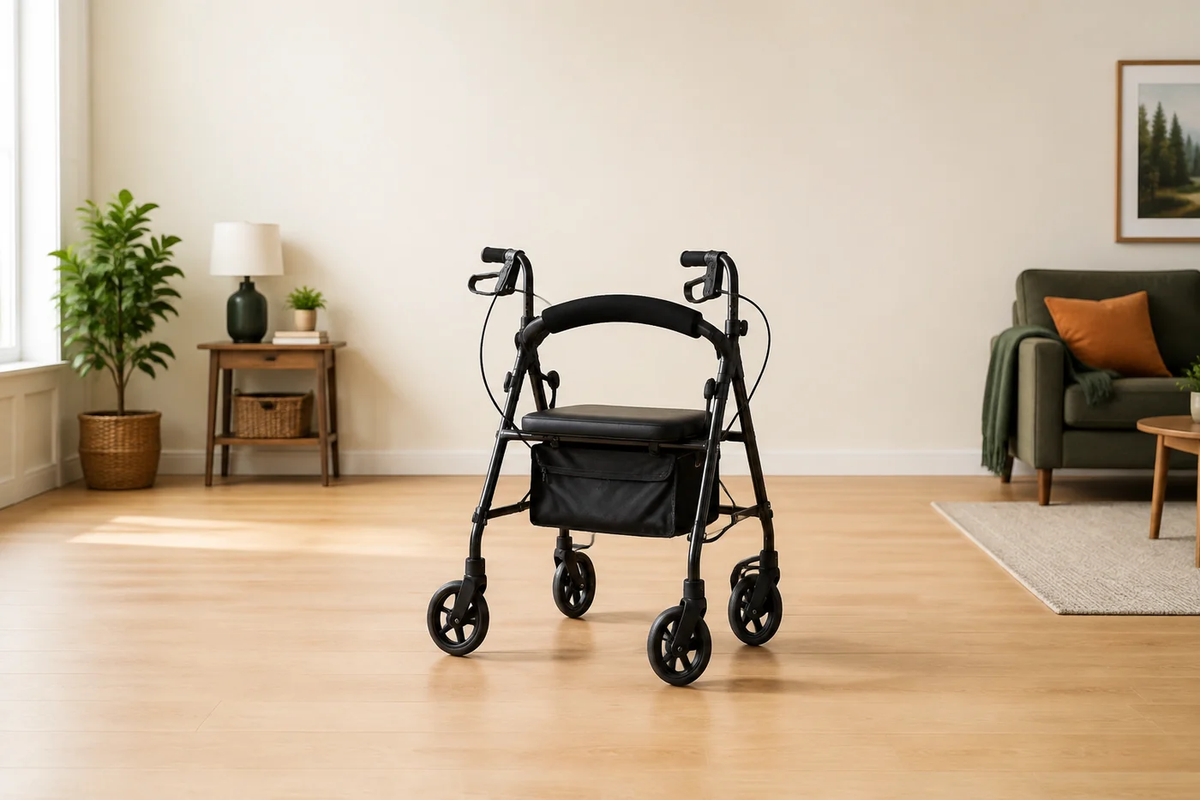
3. Rollator: continuous wheeled movement with hand brakes
A rollator moves on multiple wheels and is controlled with hand brakes. Many models include a seat and storage, which can be useful when planned rests or carrying small personal items are part of the routine.
Those features also add control requirements. The user must be able to steer, regulate speed, operate both brakes, and engage both parking brakes before sitting. A rollator needs enough turning room and must stay within the exact model’s surface and slope limits.
A standard rollator is not a wheelchair. Unless the product is specifically designed and labeled for seated transport, it should remain stationary while someone is seated.
Why “more support” is too simple
It is tempting to arrange these categories in a straight line—cane, walker, then rollator—and assume that each step automatically provides more support. That shortcut ignores what the user must do to control each device.
- A cane requires coordinated one-handed placement.
- A two-wheel walker requires both hands, room for the frame, and control of front wheels and rear tips.
- A rollator requires steering, continuous wheel control, and reliable operation of both brakes.
A feature is not an advantage if the intended user cannot control it safely. Compare the person, route, task, and exact product together rather than choosing by wheel count, product weight, or seat availability alone.
DeepTireh mobility models at a glance
| DeepTireh product | Published details |
|---|---|
| Foldable Adjustable Cane with Interchangeable Bases |
Model: HY7220L Product weight: 2.2 lb Maximum user weight: 250 lb Design: One-handed folding cane with interchangeable bases or rubber tips. |
| Foldable 2-Wheel Walker |
Model: HY8160LG-5 Product weight: 7.6 lb Maximum user weight: 300 lb Design: Two-handed frame with front wheels and rear rubber tips. |
| 17 lb Lightweight Rollator Walker with Seat |
Model: HY8516L Product weight: 17 lb Maximum user weight: 275 lb Design: Four-wheel rollator with hand brakes, a stationary-rest seat, and storage. |
Specifications can change. Recheck the live product page and current manual for the exact model before ordering or use.
Five checks that apply to every category
- Hand use and control: Confirm whether the user can keep one or both hands on the device and operate every required control.
- Fit and capacity: Review the adjustment range and maximum user weight for the exact model. Seek professional fitting when appropriate.
- Real walking route: Measure doorways, hallways, turns, thresholds, furniture gaps, and storage space.
- Surfaces and level changes: Follow the model’s stated limits; do not assume that wheels make a product suitable for every slope, curb, or outdoor surface.
- Folding and transport: Check product weight, folded dimensions, locking points, lifting requirements, and vehicle or closet space.
If you have already determined that a rollator is the appropriate category, use the separate rollator buying guide to compare handle height, seat dimensions, brakes, wheels, folded size, and storage in more detail.
Frequently asked questions
Is a rollator better than a walker?
Not in every situation. A rollator adds continuous wheels, hand brakes, and often a seat, but the user must control those features. A two-wheel walker uses front wheels and rear tips and has different movement, space, and control requirements. Suitability depends on the individual, product, and environment.
Can a rollator be used as a wheelchair?
Do not assume so. A standard rollator seat is intended for stationary rest with both parking brakes engaged. The DeepTireh HY8516L should not be moved while a person is seated and is not a substitute for a transport wheelchair.
Can a cane replace a walker?
Not simply because it is lighter or easier to carry. A cane and walker require different hand use and provide different forms of support. If the user currently uses a walker or has new weakness, balance problems, pain, a recent fall, surgery, or an injury, ask a qualified professional before changing categories.
Do all walkers have brakes and seats?
No. “Walker” can refer to several designs. A two-wheel walker may use front wheels and rear tips without hand brakes or a seat, while many four-wheel rollators include hand brakes, a seat, and storage. Verify the exact product instead of relying on the category name alone.
Does Smart NFC choose or fit the mobility aid?
No. On DeepTireh products marked NFC Ready, a compatible phone can open available model-specific setup information, product registration, and support resources. Smart NFC does not assess the user, select or fit a mobility aid, monitor safe use, or replace the product manual or professional guidance.
Compare the category before the features
Start with the device the user can control in the real environment—not the product with the longest feature list. Compare hand use, movement, braking, seating, fit, route clearance, surfaces, storage, and the instructions for each exact model.
Compare DeepTireh mobility products or contact DeepTireh Support with a product-specific question before ordering.
Further reading
- MedlinePlus: Mobility Aids
- MedlinePlus: Using a Walker
- National Institute on Aging: Falls and Fractures in Older Adults
This article provides general educational information and is not medical advice, diagnosis, treatment, or an individualized mobility or fall-risk assessment. Follow the current instructions and warnings supplied with the exact product, and consult a qualified professional when individual guidance is needed. Review the DeepTireh Medical Disclaimer & Product Safety Information.


Leave a comment
This site is protected by hCaptcha and the hCaptcha Privacy Policy and Terms of Service apply.